Tombstone placed over the grave of two brothers. The boy to the left is sitting on a grave monument. From Smyrna Credit: Image courtesy of University of Gothenburg
Recent research by Sandra Karlsson, a doctoral student
at the University of Gothenburg, indicates that the emotions we experience upon
the death of a loved one haven't really changed much since ancient times.
Perhaps some would argue Karlsson's efforts to identify the emotions
surrounding death in ancient funerary art are problematic, given our emotional
response to art is subjective and highly variable, even when it comes to a
shared experience like death. However, I think this is a potentially
promising line of research provided care is taken to be mindful of our own
feelings as we undertake the investigation.
In his book
The Empathic Civilization, Jeremy
Rifkin argues humans have in recent centuries chosen one of two disembodied
approaches to life, faith or reason. Though each goes about it
differently, both of these alternative modes downplay or denigrate the human
bodily experience; one approach favours the soul or some other means of
ultimately escaping the body, while the other takes the "I think, therefore
I am" approach that views the body as merely a necessary vehicle for
transporting the rational mind. Either way, emotions and physicality take
a back seat at best and are considered a burden to be endured and eventually
freed from at worst. Rifkin argues that our truths (which include and
transcend mere facts) arise from an embodied relational experience that unites
the emotional and rational. Therefore, we would be wise not to be so dismissive
of the totality of the bodily experience, a totality that includes both reason
and emotion:
To sum up, if reality is experience
and experience is always in relationship to the other, then the more extensive
the relationships, the deeper we penetrate the various layers of reality and
the closer we come to understanding the meaning of existence.
Truths, then, are explanations of
how everything relates together. Truths are not objective or subjective,
but rather are understandings that exist in the interstitial realm where the
"I" and "thou" come together to create a common
experiential ground. This is "reality making". (p. 155)
When we look at something like
funerary art solely for the demographic or other physical evidence it can
provide and ignore the feelings that inspired it, we miss a substantial portion
of the reality that created the art and the other practices surrounding
death. This isn't to to say we can afford to ignore the demographic or
physical data. Without it we're condemned to engage in little more than
uninformative speculation that creates confusion about the human story instead
of understanding.
However, research like that conducted by Sandra Karlsson
reminds us that there is more to the reality that led to the creation of
funerary art and other artifacts than just demographics, materials,
classifications of artistic styles, and all the rest. Human relationships
and the embodied experience that entails created the reality encompassing these
burials. The surviving material evidence is what remains of this reality for us
to investigate. This material evidence produces facts that point to a deeper
truth that often crosses the boundary of the ineffable. We need look no further
than our own feelings upon experiencing the death of a loved one to understand this.
Sources: University of Gothenburg. "Emotional expressions in ancient funerary art
served as therapy for the bereaved." ScienceDaily. ScienceDaily, 10
March 2014.
<www.sciencedaily.com/releases/2014/03/140310111708.htm>. Rifkin, Jeremy. The Empathic Civilization: The Race To Global Consciousness in a World in Crisis. New York: Penguin Group, 2009
Northern Exposure (1991): All Is Vanity, Season 2, Episode 3
"Vanity of vanities, saith the Preacher, vanity of vanities; all is vanity."
Ecclesiastes 1:2
Bog people, Egyptian mummies, elaborate Chinese imperial tombs filled with terracotta warriors, mounds dotting the English landscape, catacombs, Incan sacrificial dead... The list goes on and on. What these tell us, or what we think they tell us, can, and no doubt will, fill bookshelves and populate journals for years to come.
Amidst all the research and speculation there is a great deal of discussion of the dead's identity. "Identities are rooted in practice (Curta 2007; Jones 1997). Hence, material culture in all its varieties can serve in the construction, communication and transformation of identities as well as conveying them through time from generation to generation." That's what Howard Williams and Duncan Sayer (2009) tell us, at any rate.
Howard Williams, in his earlier 2004 paper Death Warmed Up, goes even further. For him the dead possess a kind of agency that is often overlooked by contemporary archaeologists. "...the bodies of the dead in past societies may not have had a continued consciousness from a western medical perspective, but they may have had the 'agency' to affect the actions of mourners in their social memory through their corporeality. Therefore, while archaeologists have discussed permanent monuments in many past societies as foci for the influence of 'the ancestors' and 'the past' in a general sense (e.g. Barrett, 1994), the bodies of the dead during the funeral itself need to be considered as a further influence upon social choices and social remembrance."
This is all very well and good, so far as it goes. However, as Sherlock Holmes reminds us in Sir Arthur Conan Doyle's mystery Silver Blaze, sometimes the "curious incident of the dog in the night-time" isn't what the dog did, but the fact the dog didn't do anything at all. For all the talk among archaeologists of identity, status, monumentality and all the rest, there is a large dog that doesn't do much of anything. A quick Google search using terms like "burial" or "removal of heretics", "the archaeology of crucifixion" (meaning the notorious Roman penalty for various crimes, not The Crucifixion), and other similar searches looking for indications of research into the disposal of those who died on the extreme edges of society seems to confirm that perhaps professionals involved in thearchaeology of death have reached the conclusion the dog isn't really there, or if it is there what it did during the night is of little consequence. While scholarly articles are generally lacking, some interesting things do come up when Googling to learn about how undesirables are treated upon death. For example, the Orthodox Church has published guidelines for dealing with the heterodox. When the heretic was prominent enough to receive a reasonably decent burial at a known site to begin with, the Catholic Church will apparently sometimes authorize removal to sanctified ground after declaring the person wasn't really a heretic after all, as was the case with Copernicus in 2010. However, for every person with the stature of a Copernicus, how many are there that were burned at the stake, thrown into a river, or buried in an unmarked grave along with other doubters or "malcontents"? From an archaeological perspective, unless someone finds physical traces of them they hardly existed at all, and before written language became the norm the archaeological record may be all there is to go on.
As the Northern Exposure video clip above reminds us, death is one thing every living being has in common with every other. In the case of humans, unless we get lost in the wilderness or something, our bodies are all disposed of in one way or another by those we leave behind. While the funerary practices surrounding that disposal may be able to tell us something about a person's status, or perhaps what was important to them, or their identity and so forth, there are an awful lot of people throughout history that, for one reason or another, lived on the fringes. Perhaps, as in the fictional community of Cicely, Alaska (above), they wandered into town and no one can figure out who they were or where they came from, and so their death and, in that case, cremation becomes a kind of blank slate upon which everyone projects their own fragile mortality. I suspect that in most cases, unlike in the rather laid back and reflective town of Cicely, these people were typically reviled, or at best tolerated, by the culture they were a part of. For heretics, gad flies, revolutionaries or those living in extreme poverty, removal of the unpleasant and decomposing body was often largely a necessity - a chore likely delegated to someone else of lowly status, at least when their death wasn't an event intended to make a public example of them. The Old Testament is loaded with stories of what today would be described as genocide. Are we to believe the way the victims of these types of events were gotten rid of following their deaths, assuming any evidence of them can be found at all, had anything to do with their identity or agency?
The events of the 24th of August, 1572 is a case in point. This was a tragic day in the history of France. That day and the events of the following few days would be recorded as the St. Bartholomew's Day Massacre. French Catholics, having received signals from a sympathetic king that he didn't disapprove, decided to do something about the Protestants in their midst and went on a killing spree that, over the course 3-4 days, resulted in the deaths of tens of thousands of French Huguenots throughout the country. According to Parisian city records, men were paid to remove over 1,000 bodies that had washed up on the banks of the Seine downstream from the city afterwards. For a particularly gruesome account of the killing and subsequent disposal of Gaspard II de Coligny, a leader of the Huguenots at the time, follow this link. All of this is quite reminiscent of the horrific scenes of bloated bodies floating down rivers in Rwanda during that 1990s genocide, or perhaps the terrible events in the Balkans during the same decade. While forensic anthropologists and others were able to reconstruct these more recent examples of human brutality, none were on hand prior to the 20th century to record the fate of the unmemorialized victims of past social injustices, and there were many.
As our capacity to record and share the treatment of hated enemies or those living on the margins of our society has grown, our brutality toward one another has, thankfully, diminished. Let's hope it stays that way. Regardless, those we dig up from the ancient past were not likely to have lived too far outside the mainstream of their respective cultures. The archaeology of death is in fact, in many respects, the archaeology of the mainstream or, very often, elite during the period in question. Those living on the streets, questioning authority openly, or vanquished by an army being led by a king determined to wipe his conquests from the face of the earth aren't typically the people we are studying. For them the question usually isn't one of identity, but rather invisibility.
Sources:
Duncan Sayer and Howard M. R. Williams. Mortuary Practices & Social Identities in the Middle Ages: Essays in Burial Archaeology in Honour of Heinrich Härke. Exeter: University of Exeter Press, 2009.
Williams, Howard 2004. Death Warmed up: The Agency of Bodies and Bones in Early
Anglo-Saxon Cremation Rites. Journal of Material Culture, 9, pp. 263-91
"Let us define 'collapse of a society' as a local drastic decrease in human population numbers and/or in political, economic, or social complexity." ~ Jared Diamond, Ecological Collapses of Pre-industrial Societies, 2000 Tanner Lecture
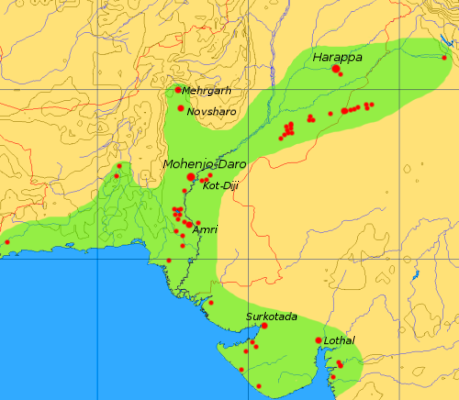
If we accept Jared Diamond's definition of pre-industrial societal collapse provided above, then the Harappan culture of the Indus Valley certainly underwent something very much like this experience around 1900 B.C. The collapse of this civilization has mystified archaeologists and historians at least since the city of Harappa was unearthed in the 1920s, and for many the best explanation for the ancient Indus civilization's disappearance was an Aryan invasion that effectively wiped it out.
An invasion by a hostile force seemed the most plausible explanation for the fall of Harappan society largely because initial indications were that it was an incredibly peaceful and egalitarian civilization. The more this view of life in the Indus Valley between 2,550 and about 1,900 B.C. became entrenched, the harder it was to imagine its demise could have been the result of anything other than hostile outside forces. Even when skeletons around cities like Harappa exhibiting signs of violent injury were unearthed, these were frequently taken as indications of massacres consistent with the invasion hypothesis rather than as possible evidence that Harappans had begun maiming and killing each other.
This all changed with a recent analysis of materials collected over the course of 26 field seasons going back to 1929 from three burial sites located outside of the ancient city of Harappa. (Schug et al., 2012) This examination revealed that, contrary to popular opinion, internal civil strife and not invading armies were the norm as Harappan society began its descent toward ultimate oblivion. The three sites are known as Cemetery R-37, Cemetery H (Stratum II and I), and Area G respectively. Cemetery R-27 is the earliest of the three, and the archaeological evidence recovered from it confirms the widely held view that Harappan culture was, during its peak, remarkably tranquil. Cemetery R-37 was used over the course of Harappa's rise and throughout its rapid growth phase from 2200 - 1900 B.C. During this period the city reached a population of 80,000 or more. Chemical analyses done on the teeth of individuals found buried in R-37 or sites like it also show that "newcomers" were arriving in the city from all over the "Indus area, perhaps for trade" at this time. Men were also likely coming to the city to find opportunities to marry Harappan women. National Geographic reports archaeologist Mark Kenoyer has found that "Many of the outsiders, surprisingly, are men buried near women native to Harappa." This indicates Harappan women likely enjoyed an uncommon degree of influence in the Harappan world. Cemetery R-37 also points to a significant level of prosperity. Graves found there contained "pottery; shell jewelry; beads of semi-precious stones, gold, and steatite; toilet objects such as mirrors, shell spoons, and small containers; and other grave goods." Of the skeletons examined that were recovered from Cemetery R-37, all formerly belonged to individuals that were "relatively healthy" with the most common condition that was clearly visible being degenerative joint disease, a condition associated with aging.
Cemetery H, however, tells another story. As Harappa began its decline (1900 - 1700 B.C.) grave goods largely disappear with only ceramics showing up among the dead. Area G, also thought to date to the same period, does contain an ossuary with "goblets, vases, and offering dishes", but these are found with 20 human crania and mandibles, many of them with signs of significant traumatic injury. (Schug et al, 2012)
At this point, Harappa begins not to look at all like its old peaceful self. "The skull of a child between four and six years old" is found that has been "cracked and crushed by blows from a club-like weapon. An adult woman was beaten so badly...that her skull caved in. A middle-aged man had a broken nose as well as damage to his forehead inflicted by a sharp-edged, heavy implement." With half the skeletons examined that date from this period showing signs of violence, Schug et al. find that a culture that was by just about every historical as well as mythical account, not to mention all available archaeological evidence, once quite peaceful quickly reached levels of violence considered high even by ancient urban standards. The violence is especially extreme, however, "when considered in the South Asian context." Head injuries have "not been frequently observed" at other burial sites "across the subcontinent", but around 1900 B.C. in Harappa they suddenly begin turning up at "the highest recorded rate in the prehistoric period thus far recorded." (Schug et al, 2012)
What happened to turn a society with a legendary reputation for peace, a reputation supported by the archaeological record, into a kind of ancient version of the Wild West? Here the archeaology of death may provide a lesson the contemporary world would be wise to heed. Regional climate change appears to be largely responsible for Harappa's shifting fortunes. As monsoonal patterns shifted and a once abundant river disappeared, Harappa began to empty out. Unfortunately for those left behind, they didn't enjoy nearly the resources their ancestors once had. Agricultural surpluses became chronic shortages. Dr. Gwen Robbin Schug leaves us with this cautionary message: "Human populations in semi-arid regions of the world, including South Asia, currently face disproportionate impacts from global climate change. The evidence from Harappa offers insights into how social and biological challenges impacted past societies facing rapid population growth, climate change and environmental degradation. Unfortunately, in this case, increasing levels of violence and disease accompanied massive levels of migration and resource stress and disproportionate impacts were felt by the most vulnerable members of society."
Sources:
Schug, Gwen Robbins, Kelsey Gray, V. Mushrif-Tripathy, and A.R. Sankhyan 2012 A Peaceful Realm? Trauma and Social Differentiation at Harappa. International
Journal of Paleopathology, 2, pp. 136-147
Schug, Gwen Robbins, K. Elaine Blevins, Brett Cox, Kelsey Gray, and V. Mushrif-Tripathy 2013 Infection, Disease, and Biosocial Processes at the End of the Indus Civilization. PLoS One, 8 (2): e84814 DOI: 10.1371/journal.pone.0084814
Given our own modern taste for beer, wine, ciders and various other alcoholic beverages, we shouldn't find it astonishing that biomolecular archaeologists like Dr. Pat McGovern of the University of Pennsylvania's Museum of Archaeology and Anthropology have been finding traces of them on shards of pottery and in the bottoms of ancient cups for years. From an archaeology of death perspective, however, what are we to make of artifacts such as strainers, wine kits imported from southern Europe, jugs of "grog" or mead, and cups that were clearly used primarily to imbibe these drinks turning up prominently in graves across Scandinavia?
"Egtved Girl" is thought to have been a priestess. She was buried in a
an oak trunk coffin sometime between 1300 and 1500 BC with a birch-bark
bucket of grog at her feet. Credit: National Museum of Denmark
Ancient drink set found in Sweden dating to the 1st century AD. Imported from Rome, analysis indicates this set was used to make grog. Credit: Nylen and Statens Historiska Museum, Stockholm
Nylen and Statens Historiska Museum, Stockholm
Nylen and Statens Historiska Museum, Stockholm
In the absence of a written record, it's extremely difficult to determine what meaning an artifact found in a grave held either for the individual it was buried with or the culture that produced it and ultimately placed it with the body. Does a knife or sword buried with a body always mean that person was a warrior? Do remains of a woman found griping a strainer and the association of wine kits with female graves mean women typically made and served drinks like grog? Self images and gender roles are probably factors here, and they can at best only be determined probabilistically.
However, when it comes to cups and jugs containing grog residue, these have been found in both male and female Scandinavian burial sites . This may have some religious significance. On the other hand, the presence of these artifacts may simply mean, then as now, people appreciated the socially lubricating qualities of a good drink and memories of the dead were strongly linked to social gatherings where grog played a central role. As Freud supposedly said, "sometimes a cigar is just a cigar". Since the people burying these cups, jugs, and buckets along with their dead didn't write down why they were doing it, we will likely never know exactly what was going through their minds at the time.
Wine was occasionally imported from the south to add to grog as an extra ingredient. It was probably as a consequence of this commerce that at least a few Greeks and Romans became familiar with the drink. It doesn't appear they were too concerned with any, to them, unusual religious or other cultural roles grog played for their northern European neighbors. However, they did notice its taste and they didn't consider it very savory. The blog Live Science points out the criticism of these Greeks and Romans may provide evidence of the first wine snobs; they thought grog tasted like "barley rotted in water".
Regardless of what the ancient Greeks and Romans thought, or what grog meant to its primary consumers, you can decide for yourself what you think of the beverage. Relying in part upon the analyses conducted on containers found in Nordic graves going back as far as 3,500 years, the Deleware based brewery Dogfish Head has created its version of the recipe. Marketed under the name Kvasir, Dogfish's recreation of Nordic grog is just the latest in its line of ancient brews available for those literally seeking a taste of drinks that frequently inspired our ancestors to take full jars and buckets to the grave with them. Perhaps in the near future the University of Victoria will be adding an Archaeology of Beer course to the menu as well.
Ancient
texts written by Greeks and Romans proved that southern Europeans were
among the first wine snobs — these authors dismissed Northern beverages
as "barley rotted in water." - See more at:
http://www.livescience.com/42559-nordic-grog-ancient-alcoholic-beverage.html#sthash.hDhfsL41.dpuf
Ancient
texts written by Greeks and Romans proved that southern Europeans were
among the first wine snobs — these authors dismissed Northern beverages
as "barley rotted in water." - See more at:
http://www.livescience.com/42559-nordic-grog-ancient-alcoholic-beverage.html#sthash.hDhfsL41.dpuf
Ancient
texts written by Greeks and Romans proved that southern Europeans were
among the first wine snobs — these authors dismissed Northern beverages
as "barley rotted in water." - See more at:
http://www.livescience.com/42559-nordic-grog-ancient-alcoholic-beverage.html#sthash.hDhfsL41.dpuf
Ancient
texts written by Greeks and Romans proved that southern Europeans were
among the first wine snobs — these authors dismissed Northern beverages
as "barley rotted in water." - See more at:
http://www.livescience.com/42559-nordic-grog-ancient-alcoholic-beverage.html#sthash.hDhfsL41.dpuf
The Death Takes a Field Trip blog is a project initiated as part of the Archaeology of Death course at the University of Victoria. All posts will be by Craig Axford. There will be at least one post each week. Posts will be inspired either by discussions taking place in class, readings, or research conducted for the course.
I believe the Archaeology of Death provides a window into culture
that few other perspectives can. Other than birth, death
is really the only experience every single one of us ultimately shares,
but paradoxically it is also an experience we can't really share
except with the living. The things we do to the dead, the
objects we leave in their graves, and the funerary rituals we perform to
mark someone's death are manifestations of the way our respective cultures view
life as much or more than they are indications of the way we viewed the individual(s) who has died.
About the author: I am in my final term at the University of Victoria finishing degrees in both anthropology and environmental studies. My wife and I moved to Victoria from Salt Lake City, Utah in 2010. We hope to remain in British Columbia permanently following my graduation. Prior to coming to Canada, I worked as program director for an environmental non-profit focused on US National Forest protection, and later as an organizer for the Democratic National Committee (DNC).