"Let us define 'collapse of a society' as a local drastic decrease in human population numbers and/or in political, economic, or social complexity." ~ Jared Diamond, Ecological Collapses of Pre-industrial Societies, 2000 Tanner Lecture
 |
| A Harappa's males skull exhibitng signs of traumatic injury. Photograph courtesy Gwen Robbins Schug |
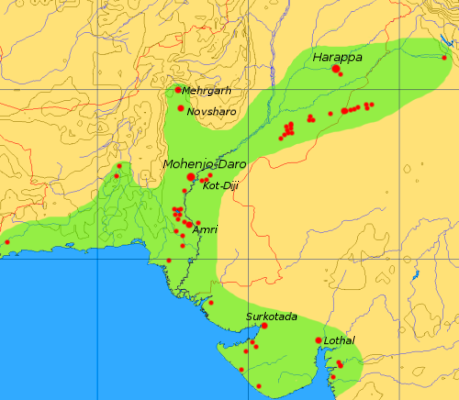 |
| Major cities of the Indus Valley Civilization. Source: Wikipedia |
An invasion by a hostile force seemed the most plausible explanation for the fall of Harappan society largely because initial indications were that it was an incredibly peaceful and egalitarian civilization. The more this view of life in the Indus Valley between 2,550 and about 1,900 B.C. became entrenched, the harder it was to imagine its demise could have been the result of anything other than hostile outside forces. Even when skeletons around cities like Harappa exhibiting signs of violent injury were unearthed, these were frequently taken as indications of massacres consistent with the invasion hypothesis rather than as possible evidence that Harappans had begun maiming and killing each other.
This all changed with a recent analysis of materials collected over the course of 26 field seasons going back to 1929 from three burial sites located outside of the ancient city of Harappa. (Schug et al., 2012) This examination revealed that, contrary to popular opinion, internal civil strife and not invading armies were the norm as Harappan society began its descent toward ultimate oblivion. The three sites are known as Cemetery R-37, Cemetery H (Stratum II and I), and Area G respectively. Cemetery R-27 is the earliest of the three, and the archaeological evidence recovered from it confirms the widely held view that Harappan culture was, during its peak, remarkably tranquil. Cemetery R-37 was used over the course of Harappa's rise and throughout its rapid growth phase from 2200 - 1900 B.C. During this period the city reached a population of 80,000 or more. Chemical analyses done on the teeth of individuals found buried in R-37 or sites like it also show that "newcomers" were arriving in the city from all over the "Indus area, perhaps for trade" at this time. Men were also likely coming to the city to find opportunities to marry Harappan women. National Geographic reports archaeologist Mark Kenoyer has found that "Many of the outsiders, surprisingly, are men buried near women native to Harappa." This indicates Harappan women likely enjoyed an uncommon degree of influence in the Harappan world. Cemetery R-37 also points to a significant level of prosperity. Graves found there contained "pottery; shell jewelry; beads of semi-precious stones, gold, and steatite; toilet objects such as mirrors, shell spoons, and small containers; and other grave goods." Of the skeletons examined that were recovered from Cemetery R-37, all formerly belonged to individuals that were "relatively healthy" with the most common condition that was clearly visible being degenerative joint disease, a condition associated with aging.
Cemetery H, however, tells another story. As Harappa began its decline (1900 - 1700 B.C.) grave goods largely disappear with only ceramics showing up among the dead. Area G, also thought to date to the same period, does contain an ossuary with "goblets, vases, and offering dishes", but these are found with 20 human crania and mandibles, many of them with signs of significant traumatic injury. (Schug et al, 2012)
At this point, Harappa begins not to look at all like its old peaceful self. "The skull of a child between four and six years old" is found that has been "cracked and crushed by blows from a club-like weapon. An adult woman was beaten so badly...that her skull caved in. A middle-aged man had a broken nose as well as damage to his forehead inflicted by a sharp-edged, heavy implement." With half the skeletons examined that date from this period showing signs of violence, Schug et al. find that a culture that was by just about every historical as well as mythical account, not to mention all available archaeological evidence, once quite peaceful quickly reached levels of violence considered high even by ancient urban standards. The violence is especially extreme, however, "when considered in the South Asian context." Head injuries have "not been frequently observed" at other burial sites "across the subcontinent", but around 1900 B.C. in Harappa they suddenly begin turning up at "the highest recorded rate in the prehistoric period thus far recorded." (Schug et al, 2012)
What happened to turn a society with a legendary reputation for peace, a reputation supported by the archaeological record, into a kind of ancient version of the Wild West? Here the archeaology of death may provide a lesson the contemporary world would be wise to heed. Regional climate change appears to be largely responsible for Harappa's shifting fortunes. As monsoonal patterns shifted and a once abundant river disappeared, Harappa began to empty out. Unfortunately for those left behind, they didn't enjoy nearly the resources their ancestors once had. Agricultural surpluses became chronic shortages. Dr. Gwen Robbin Schug leaves us with this cautionary message: "Human populations in semi-arid regions of the world, including South Asia, currently face disproportionate impacts from global climate change. The evidence from Harappa offers insights into how social and biological challenges impacted past societies facing rapid population growth, climate change and environmental degradation. Unfortunately, in this case, increasing levels of violence and disease accompanied massive levels of migration and resource stress and disproportionate impacts were felt by the most vulnerable members of society."
Sources:
Schug, Gwen Robbins, Kelsey Gray, V. Mushrif-Tripathy, and A.R. Sankhyan
2012 A Peaceful Realm? Trauma and Social Differentiation at Harappa. International
2012 A Peaceful Realm? Trauma and Social Differentiation at Harappa. International
Journal of Paleopathology, 2, pp. 136-147
Schug, Gwen Robbins, K. Elaine Blevins, Brett Cox, Kelsey Gray, and V. Mushrif-Tripathy
2013 Infection, Disease, and Biosocial Processes at the End of the Indus Civilization.
PLoS One, 8 (2): e84814 DOI: 10.1371/journal.pone.0084814
"Climate change key to collapse of ancient Indus civilization", CBC News, June 25, 2012
"Surprising Discoveries From the Indus Civilization: Archaeologists say the Indus civilization wasn’t nearly as peaceful as popularly thought", National Geographic Daily News, April 29, 2013"Early Civilization in the Indus Valley", USHistory.org

No comments:
Post a Comment